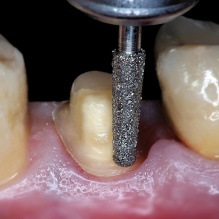
Zirconia has revolutionized restorative dentistry. Its unique combination of exceptional strength, biocompatibility, and improving aesthetics has made it a go-to material for everything from single posterior crowns to full-arch bridges. However, the long-term success of any zirconia restoration is not solely dependent on the material itself; it begins with the foundation you create—the tooth preparation.
A common misconception is that because zirconia is so strong, preparation is less critical. The opposite is true. Precision preparation is paramount to prevent failures, ensure a passive fit, and achieve optimal aesthetic and functional outcomes.
This guide will break down the essential requirements and parameters for preparing teeth for both monolithic and porcelain-fused-to-zirconia (PFZ) restorations.
The Universal Principles of Zirconia Preps
- Before we dive into the specifics of each type, some core principles apply to ALL zirconia preparations. These are non-negotiable for success with CAD/CAM milled restorations.Smooth, Rounded Line Angles: This is the most critical rule. Sharp internal line angles and corners create points of stress concentration within the zirconia substructure. During milling, the CAD/CAM bur cannot replicate sharp angles, leading to an ill-fitting restoration that will be under tension. Avoid sharp angles at the junction of the axial walls and occlusal surface, as well as in the finish line.
- Conservative Taper: An ideal axial wall taper is between 6∘ and 8∘ total occlusal convergence. This provides adequate retention and resistance form while ensuring a passive path of insertion without undercuts.
- Defined and Readable Margins: Your dental lab technician will thank you. A clear, continuous margin is essential for the scanner to accurately capture the preparation's edge. This translates directly to a well-fitting crown.
- Avoid Undercuts: The restoration must have a clear path of insertion. Any undercut will prevent the crown from seating fully, leading to an open margin or the need for significant adjustment, which can weaken the material.
Type 1: Monolithic Zirconia (Full-Contour Zirconia)
Monolithic zirconia is milled from a single, solid block of zirconia. It is prized for its immense strength, making it the ideal choice for posterior teeth, bruxers, and cases with limited occlusal clearance. Modern high-translucency monolithic materials also offer excellent aesthetics for anterior restorations.
Since there is no porcelain overlay, preparations for monolithic zirconia can be more conservative.
Preparation Parameters for Monolithic Zirconia:
- Occlusal Reduction: A minimum of 1.0 mm is required, but 1.2 to 1.5 mm is ideal. This provides sufficient material thickness for strength and allows for anatomical contouring. For high-translucency anterior zirconia, 1.5 mm of incisal reduction helps achieve better light transmission and aesthetics.
- Functional Cusp Bevel: Always place a wide, 45∘ bevel on the functional cusps (lingual of maxillary posteriors, buccal of mandibular posteriors). This ensures uniform material thickness in areas of high occlusal stress.
- Axial Reduction: A conservative reduction of 0.5 to 1.0 mm is sufficient.
- Margin Design: A chamfer margin is the gold standard. It provides a distinct finish line that is easy to read and provides adequate bulk at the margin. A depth of 0.5 mm is typically sufficient. A rounded shoulder is also acceptable, but avoid knife-edge margins at all costs, as they result in a thin, weak area prone to chipping and over-contouring.
Type 2: Porcelain-Fused-to-Zirconia (PFZ)
PFZ restorations consist of a milled zirconia core (substructure) with a hand-layered porcelain overlay. This approach combines the strength of the zirconia core with the supreme aesthetics of porcelain, making it an excellent choice for highly aesthetic anterior cases.
The key difference in preparation is the need for greater reduction to accommodate two materials: the core and the veneering porcelain.
Preparation Parameters for PFZ:
- Occlusal/Incisal Reduction: A significant reduction of 1.8 to 2.0 mm is necessary. This provides space for a supportive zirconia core (approx. 0.5 mm) and an adequate thickness of porcelain (1.3−1.5 mm) for optimal aesthetics and to prevent fracture.
- Axial Reduction: A uniform axial reduction of 1.2 to 1.5 mm is required. This is especially important on the facial/buccal surface to allow for sufficient porcelain thickness for translucency and shade matching.
- Margin Design: A rounded shoulder or heavy chamfer with a depth of 1.0 to 1.2 mm is ideal. This provides a robust "butt joint" for the porcelain and structural support for the entire restoration.
Quick-Reference Summary
Occlusal/Incisal Reduction
- Monolithic Zirconia: 1.0−1.5 mm
- PFZ: 1.8−2.0 mm
Axial Reduction
- Monolithic Zirconia: 0.5−1.0 mm
- PFZ: 1.2−1.5 mm
Margin Design
- Monolithic Zirconia: Chamfer
- PFZ: Rounded Shoulder / Heavy Chamfer
Margin Depth
- Monolithic Zirconia: 0.5 mm
- PFZ: 1.0−1.2 mm
Final Polish: The Finishing Touches
Regardless of the zirconia type, the final step of your preparation is critical: smoothing. Use a fine-grit diamond bur to smooth all surfaces and round any remaining sharp angles. A smooth, polished prep not only improves the fit but also reduces stress on the final restoration.
Conclusion
The success of a zirconia crown or bridge is a partnership between the clinician and the dental laboratory, and it starts in the operatory. By adhering to these evidence-based preparation guidelines—respecting the need for smooth contours, adequate reduction for the chosen material, and well-defined margins—you create the ideal foundation for a restoration that is strong, aesthetic, and built to last.
At Chase Dental Lab, we collaborate with clinicians to craft monolithic and PFZ crowns and bridges that honor your prep work and refine esthetics. Each restoration is designed for seamless integration — enhancing both function and form.
Disclaimer: The information provided in this article is for educational purposes only and is not intended to replace independent clinical judgment. Clinicians should evaluate each case individually and follow manufacturer instructions, current evidence-based guidelines, and their own professional expertise. Chase Dental Lab assumes no responsibility for patient outcomes resulting from the application of the information presented here.